Research Papers
Latest publications from our group
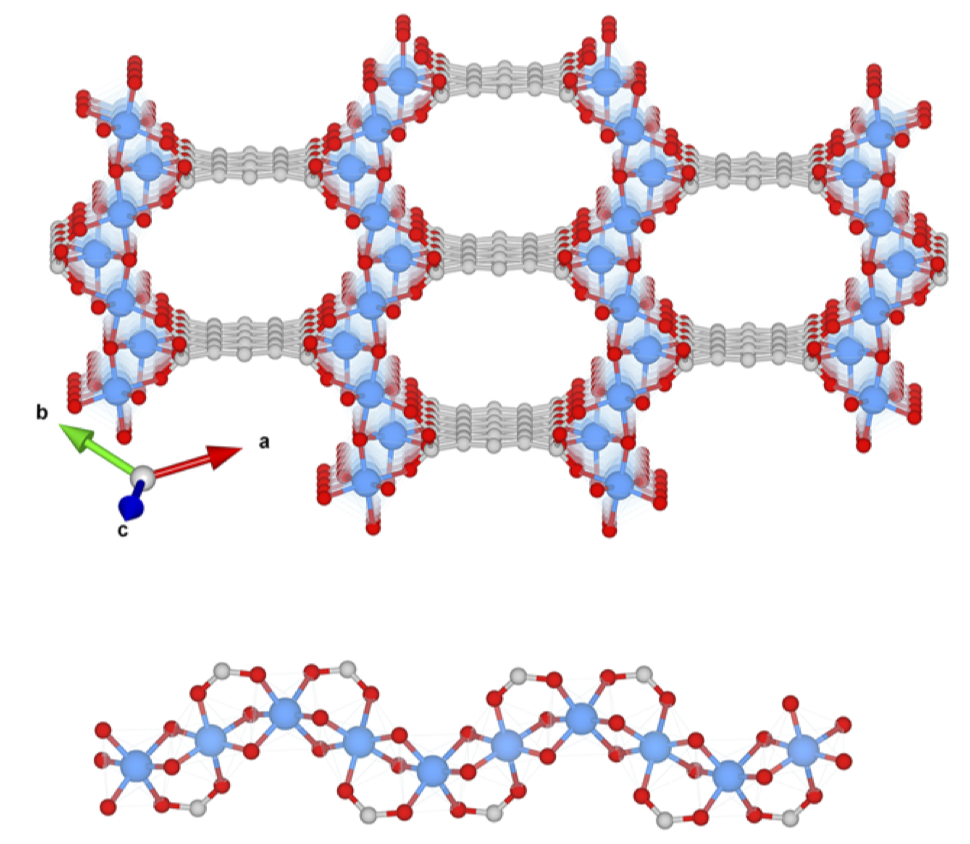
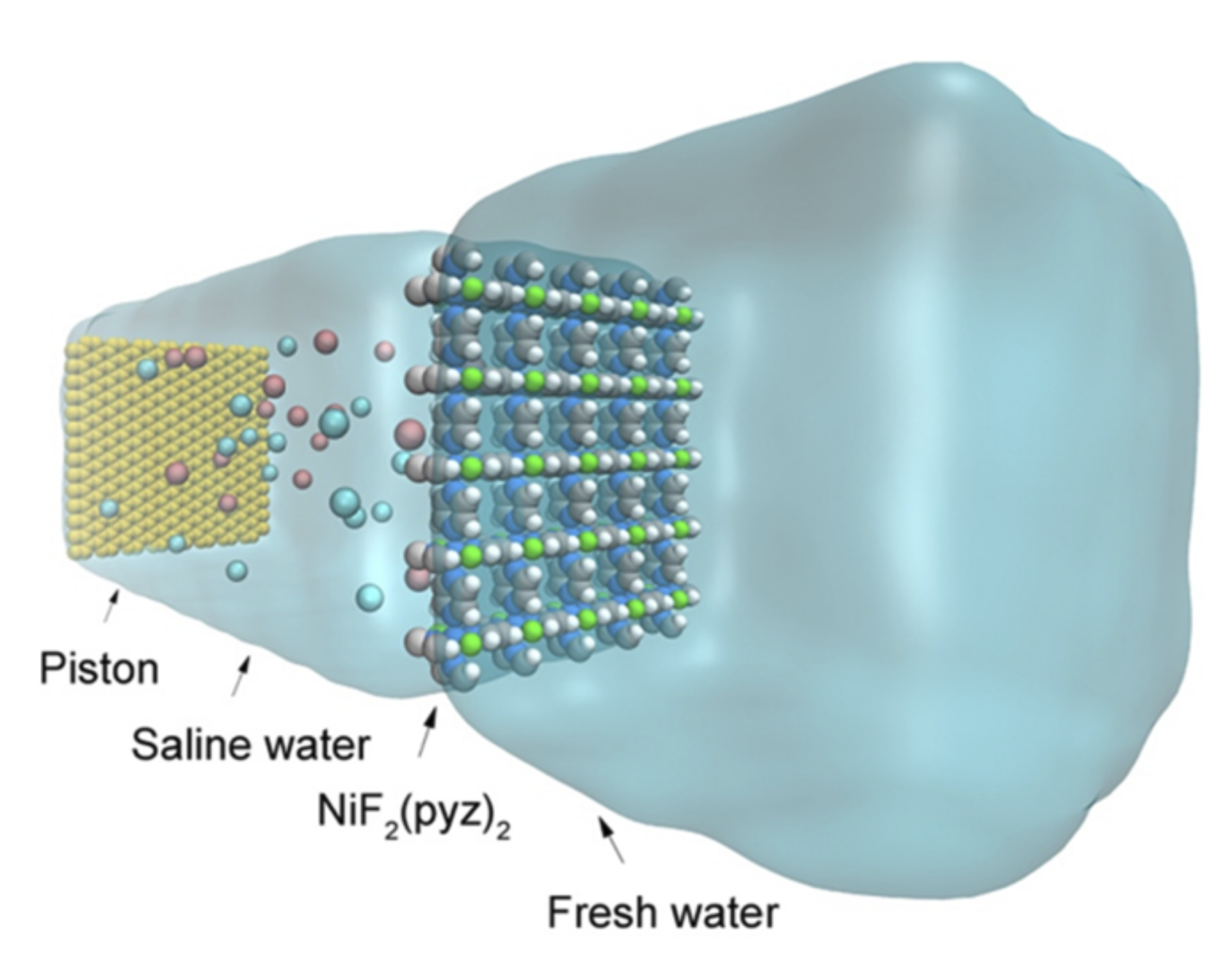
Water scarcity remains one of the most pressing global challenges, driving the urgent need for next-generation desalination technologies that can overcome the long-standing trade-off between water permeability and ion selectivity. Here, we introduce a molecular design blueprint based on a two-dimensional metal−organic framework (2D-MOF) monolayer, NiF2(pyz)2, featuring intrinsically aligned ∼4 Å pores and high structural regularity. Using systematic all-atom molecular dynamics simulations, we demonstrate that this monolayer achieves ultrahigh water permeability while maintaining 100% Na+/Cl− rejection across a wide range of applied pressures. We attribute this exceptional performance to a synergistic combination of low interfacial water density, reduced free energy barriers for water transport, and a high pore area-to-surface area ratio, captured by a proposed dimensionless descriptor. Compared to conventional 2D membranes with artificial nanopores, which often suffer from fabrication complexity, pore size variability, and mechanical fragility, the NiF2(pyz)2 monolayer offers a robust alternative with precisely defined nanochannels combined with mechanical and hydrothermal stability. This work pushes the boundaries of the structure−function paradigm in membrane science by establishing that atomically engineered intrinsic porosity, rather than postfabricated artificial channels, is the key to achieving fast and selective water transport. Our findings lay the groundwork for the rational design of high-efficiency desalination membranes and suggest possible approaches for using MOFs in sustainable water purification technologies.
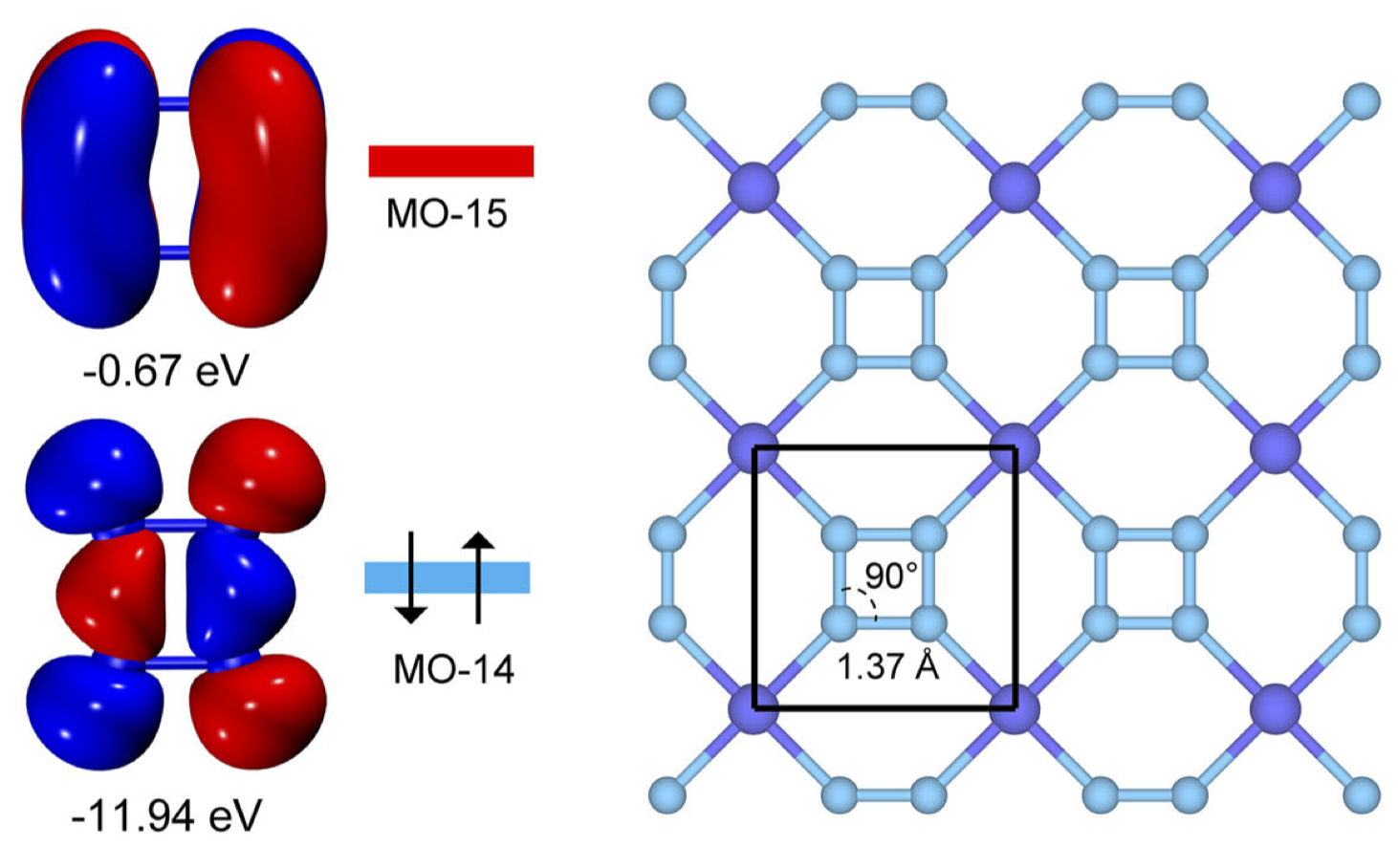
Synthesizing polynitrogen compounds that remain stable at ambient conditions is particularly challenging because species beyond the N ≡ N triple bond are inherently unstable. In this study, we combine first-principles calculations with a machine-learning potential (MLP) to investigate the ambient stability of planar cyclo-N4 units embedded in a two-dimensional t-FeN4 monolayer. Our results show that strong Fe–N coordination inhibits N ≡ N reformation, enabling the square cyclo-N4 motif to remain dynamically stable and covalently bonded without high-pressure synthesis. Furthermore, this structure exhibits tunable magnetic anisotropy and a Néel temperature above 600 K, indicating potential for room-temperature spintronic applications. The MLP also enables the simulation of systems comprising over 100,000 atoms, including periodic sheets, nanoribbons, nanomatrices and nanosheets, revealing their structural integrity under thermal fluctuations. These results demonstrate that two-dimensional confinement provides a promising route to stabilize exotic nitrogen topologies, linking quantum-mechanical accuracy with mesoscale modelling for future spin-based technologies.